Handwriting and Your Brain
For years and years I’ve read about Julia Cameron’s Morning Pages, a daily steam-of-consciousness writing practice designed to clear your brain for creativity. Back in the day I read The Artist’s Way. I’ve listened to Julia on podcasts and read blog post after blog post witnessing amazing results. Still I wasn’t convinced.
I told myself I was too busy so I never really tried them.
Back in June as part of my health coach training I read (again) about Morning Pages and thought, Sheesh, we’re still talking about this?! But, I felt the prick and decided for me it was time—I would commit to one month and see what I could learn.
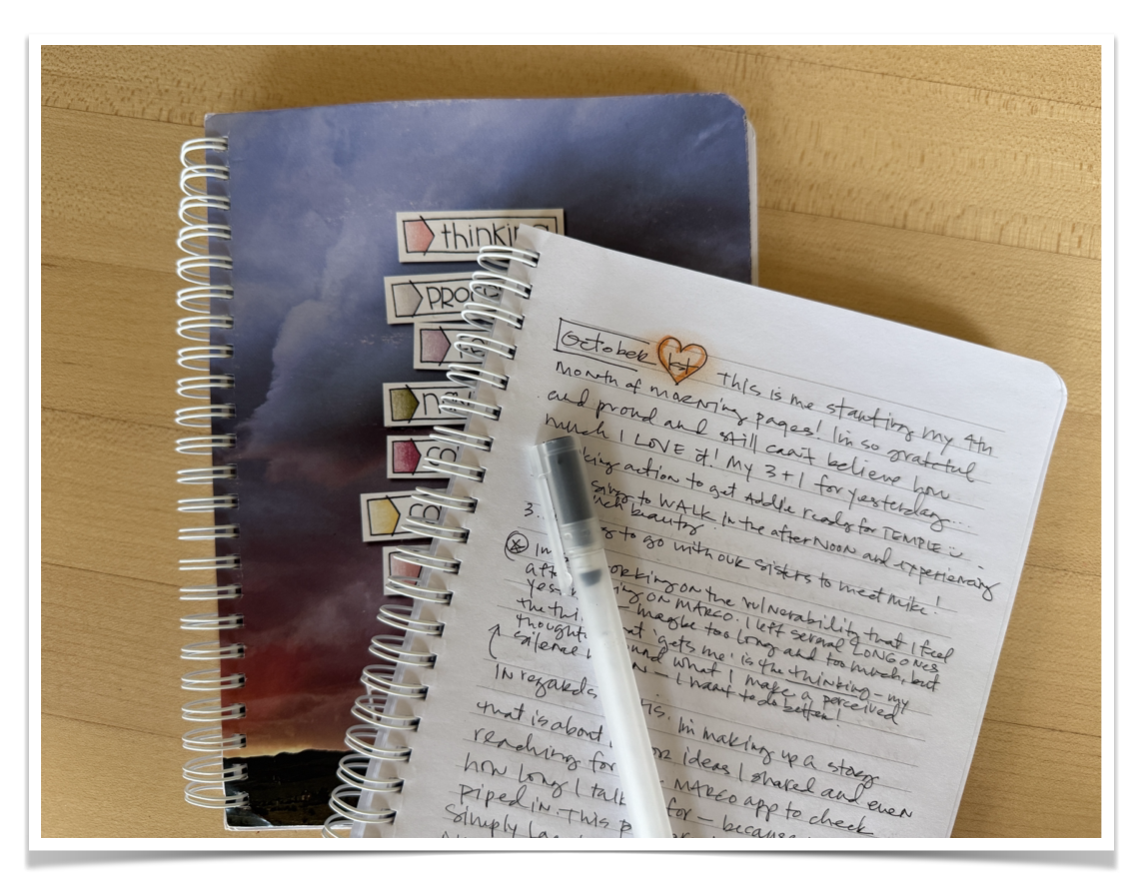
I had three new Becky Higgins notebooks, so I chose one, opened to the first blank page, wrote ‘July 1’ and started. Honestly I didn’t know what to write. This is actually how I started … “I’m not sure what to write, but I’ve finally committed to this morning pages thing, so here goes nothing … “ My hand felt tired at the bottom of page one (Julia suggests writing 3 pages a day) but I managed three pages and continued.
Yesterday, I opened a fresh notebook and wrote ‘October 1st’ at the top. Girls, I’m telling you. I LOVE Morning Pages! Have I written every single day? No. But I can count the days I’ve missed with my 10 fingers. I’m so freaking proud of myself and so grateful for what this practice has added to my morning routine. I have documented so many details, processed feelings and captured BIG and little ideas.
Not long after I began, my friend sent me a YouTube conversation with Dr. Craig Manning on the Just Ingredients podcast. I love it so much I’m sharing it with you.
Dr. Manning, a human performance coach, talks about the power of words and the unique connection between handwriting and neuroplasticity—essentially that handwriting requires considerable coordination. Your brain has to decide what you want to say, retrieve letters and words, plan their shapes, control fine motor movements, monitor what appears on the page, and continuously adjust. Writing by hand is not merely recording a thought. It is a whole-brain activity that can help build and reinforce the pathways involved in that thought. And the words we choose to write are foundational to our cognition and growth.
I know this is a LOT to read.
If you’ve made it this far, I happy to report that my hands are no longer tired when I write in the morning and that my brain feels more capable of creative expression. I want and need this and couldn’t be more grateful for this experiment and outcome!
If like me you’ve become very dependent on your Notes app or laptop or any other kind of very useful typewritten or voice command composition. Here’s my challenge: Try some handwriting. It is NOT inefficient. In truth it is a very special connection between your conscious thought and your brain’s attic of memories.
Our thoughts move much faster than our hands can write. Normally, we might consider that a disadvantage. But when we're trying to truly think, to process, to remember, slowing down can be exactly what we need. AND, memory is wonderfully associative. One detail can lead to another, which leads to another. The physical act of handwriting may help create the conditions for those associations to surface because you're giving your attention to the memory rather than racing to capture it.
So much more to explore here, for now suffice it to say I have refreshed my love of and need for writing by hand—in the early morning so that I can think, process, reflect and remember, feel grateful and more intentionally invite new thoughts and ideas into my mind and life. ✍🏼 Turns out Julia was right all along!